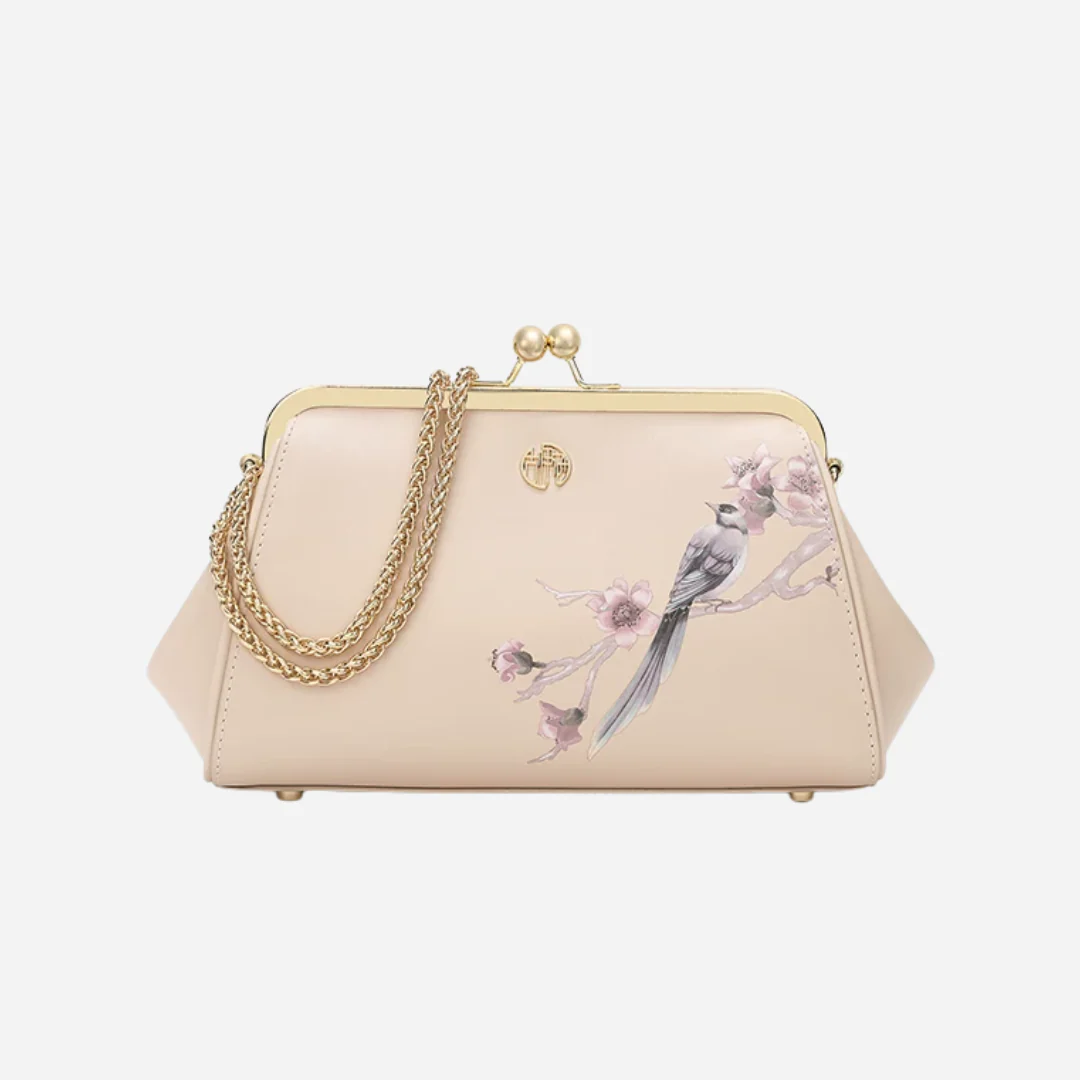
Tang Imperial 28 Ink Magpie Clutch
Tang Heritage's Limited Time Sale to Commemorate Crossing 4,000 Reviews!
Celebrate with us—order now to claim:
1. 10% OFF Your First Order + 30-days Heritage Refund Guarantee

2. Gold Metal Authenticity Card (To Certify A Tang Original)

3. Unique Engraved Serial Number

4. Premium Gift Packaging (Worth $30)

In China, before a letter arrives. Before the news is spoken aloud. Before the door opens. There is the magpie.
For over two thousand years, the magpie (喜鹊, xǐquè) has been the bird of joyful tidings in Chinese culture. Its name carries 喜 — the character for happiness, for celebration, for good fortune arriving. When a magpie called from a branch outside your window, the ancients understood it as a promise: something good is on its way.
It appears in Tang dynasty poetry. It is painted in Song dynasty court albums alongside plum blossoms in full bloom. It is hung at weddings, displayed at New Year, given as a gift when there is something worth celebrating. In the classical Chinese imagination, the magpie does not simply observe the world. It announces it.
This bag carries that announcement quietly, on leather, wherever you take it.
The Motif — 喜鹊 (Xǐquè)
The magpie on this bag is never alone. It perches among plum blossoms (梅花), a pairing so established in Chinese visual culture that it has its own classical name: 喜上眉梢 (xǐ shàng méi shāo). The phrase is a homophone pun, its sounds meaning simultaneously "the magpie on the plum branch" and "joy rising to the tips of one's brow." It is the kind of layered meaning that classical Chinese art does quietly and constantly: the image says one thing, the sound of it says another, and the tradition behind both says a third.
The composition is drawn from 花鸟画 (huāniǎo huà), the classical bird-and-flower genre that reached its height under Song dynasty imperial patronage. The three studies in the series imagery — magpie perched, paired, and in flight — follow the compositional logic of that tradition directly: each pose a different expression of the same living subject, the same classical practice of studying a bird not as a symbol but as a presence.
The Technique — 工笔与渲染 (Gōngbǐ & Xuànrǎn)
- Gōngbǐ 工笔 — Meticulous Brushwork: The tradition of court painters: precise, deliberate, exacting. Each feather is rendered with individual attention — direction, weight, the slight variation in tone from shaft to tip. A gōngbǐ bird is not approximated. It is built, stroke by stroke, until it is present on the page.
- Xuànrǎn 渲染 — Layered Wash: The technique of building tone gradually through repeated applications of diluted ink or colour, each layer drying before the next is applied. It is how classical painters achieved the soft gradation of a bird's plumage, the blush of a petal, the atmospheric depth of a branch receding into mist. On this bag, xuànrǎn is what gives the magpie its feathered weight; the sense that it could lift off.
- The Composition, Carried on Leather: The motif is applied through a precision print process that preserves the layered gradation of the original painting technique. The result is a surface where the magpie's crown is ink-dark, its belly soft and pale, and the plum blossoms behind it carry the faint flush of early spring. This is not a pattern. It is a painting that happens to be a bag.
Premium Materials
- Split Leather Body — The exterior is crafted in split leather, offering the substantial feel and natural surface of genuine leather in a structure supple enough to be carried as a clutch and structured enough to hold its form on a table.
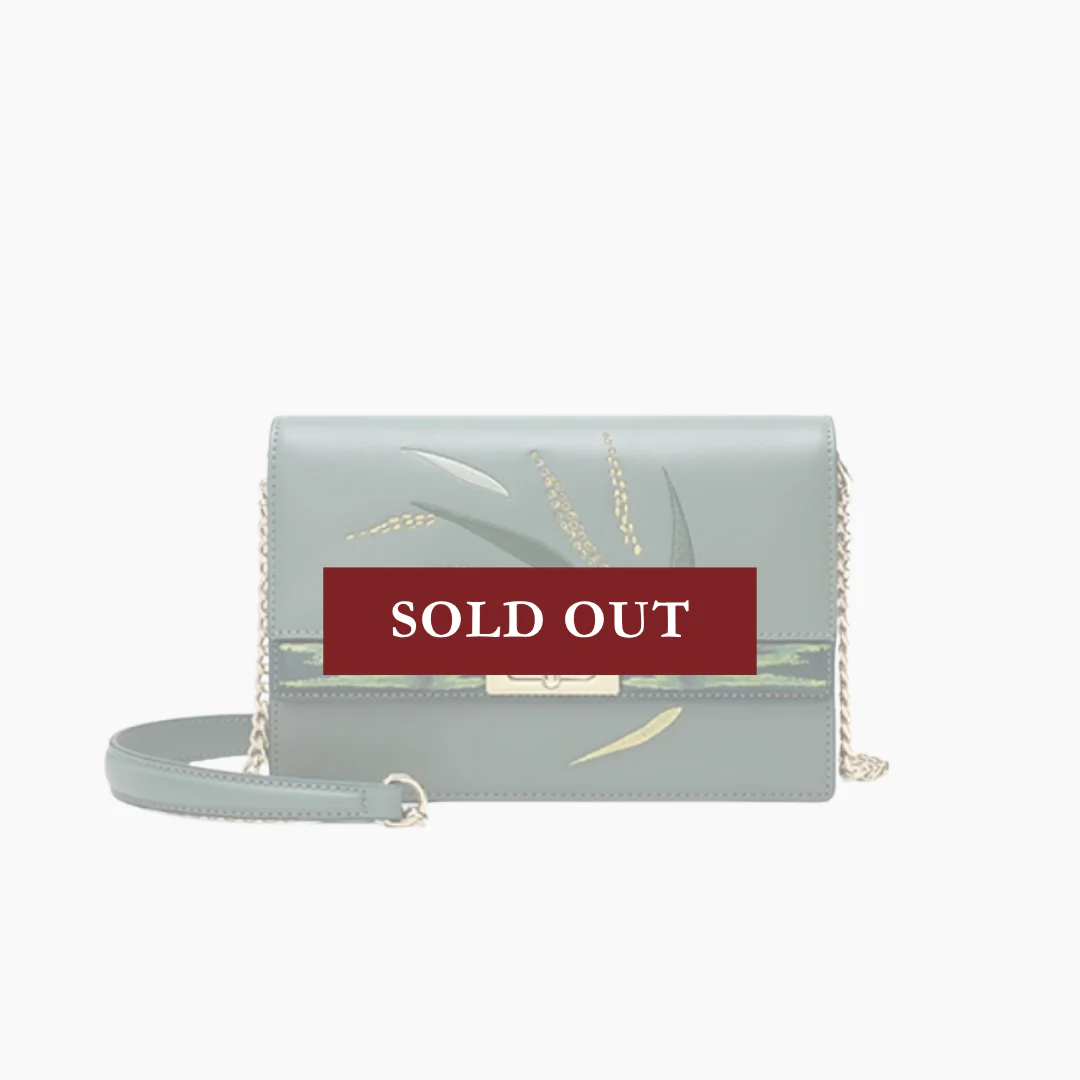
- Kiss-Lock Frame with Twin Ball Clasp — The top frame is the bag's defining feature: a full-width gold bar that opens with the press of two orb clasps meeting at centre. This closure style carries its own history: the kiss-lock frame rose to prominence in the elegant accessories of early 20th-century China, becoming synonymous with the refined femininity of the era. To open it is to perform a small, satisfying ritual. To close it is to seal something worth keeping.
- Woven Gold Chain Strap — The shoulder chain is a fully woven wheat-link gold chain: no leather pad, no interruption. Folded double, it shortens to 29cm and functions as a wrist strap or short carry; extended to 53cm, it falls as a full crossbody length. Two ways to wear it. One chain that handles both without compromise.
Product Details
- Style: Tang Imperial 28 Ink Magpie Clutch
- Dimensions: 28cm (W) × 15.5cm (H) × 10.5cm (D)
- Exterior: Split leather, parchment
- Hardware: Multi-layer electroplated gold, kiss-lock frame with twin ball clasp
- Carry modes: Wrist / short carry (chain folded, 29cm) · Crossbody / shoulder (chain extended, 53cm)
- Strap: Woven wheat-link gold chain, lobster clasp fastening
- Capacity: Fits an iPhone 13
- Colour available: Parchment (裸色)
What This Bag Is Really For
There are bags for errands and bags for evenings. This one is for the evenings that become the kind of evening you remember. The kind where the clutch stays on the table beside your glass, and someone asks about it before they ask about anything else.
Wear the chain short and carry it at the wrist. Extend it and let it fall across the body. Either way, the magpie faces outward, long tail feathers trailing, entirely at ease — which is exactly the energy worth arriving with.
Authenticity & Craft
Every Tang Heritage piece is produced in limited quantities. The motif on this bag is not mass-printed. It is applied through a precision craft process that honours the brushstroke and layered-wash logic of the original painting tradition it references. Each bag is inspected before it leaves the workshop. When a design is retired, it does not return.
Every Tang Heritage piece comes with a metal authenticity card and a unique engraved serial number, verifiable directly with us at any time.
The magpie has been perched on the plum branch in Chinese painting for a thousand years. It is still bringing good news.
Product Information
Product Information
Shipping & Returns
Shipping & Returns
Description
Tang Heritage's Limited Time Sale to Commemorate Crossing 4,000 Reviews!
Celebrate with us—order now to claim:
1. 10% OFF Your First Order + 30-days Heritage Refund Guarantee
2. Gold Metal Authenticity Card (To Certify A Tang Original)
3. Unique Engraved Serial Number
4. Premium Gift Packaging (Worth $30)
In China, before a letter arrives. Before the news is spoken aloud. Before the door opens. There is the magpie.
For over two thousand years, the magpie (喜鹊, xǐquè) has been the bird of joyful tidings in Chinese culture. Its name carries 喜 — the character for happiness, for celebration, for good fortune arriving. When a magpie called from a branch outside your window, the ancients understood it as a promise: something good is on its way.
It appears in Tang dynasty poetry. It is painted in Song dynasty court albums alongside plum blossoms in full bloom. It is hung at weddings, displayed at New Year, given as a gift when there is something worth celebrating. In the classical Chinese imagination, the magpie does not simply observe the world. It announces it.
This bag carries that announcement quietly, on leather, wherever you take it.
The Motif — 喜鹊 (Xǐquè)
The magpie on this bag is never alone. It perches among plum blossoms (梅花), a pairing so established in Chinese visual culture that it has its own classical name: 喜上眉梢 (xǐ shàng méi shāo). The phrase is a homophone pun, its sounds meaning simultaneously "the magpie on the plum branch" and "joy rising to the tips of one's brow." It is the kind of layered meaning that classical Chinese art does quietly and constantly: the image says one thing, the sound of it says another, and the tradition behind both says a third.
The composition is drawn from 花鸟画 (huāniǎo huà), the classical bird-and-flower genre that reached its height under Song dynasty imperial patronage. The three studies in the series imagery — magpie perched, paired, and in flight — follow the compositional logic of that tradition directly: each pose a different expression of the same living subject, the same classical practice of studying a bird not as a symbol but as a presence.
The Technique — 工笔与渲染 (Gōngbǐ & Xuànrǎn)
- Gōngbǐ 工笔 — Meticulous Brushwork: The tradition of court painters: precise, deliberate, exacting. Each feather is rendered with individual attention — direction, weight, the slight variation in tone from shaft to tip. A gōngbǐ bird is not approximated. It is built, stroke by stroke, until it is present on the page.
- Xuànrǎn 渲染 — Layered Wash: The technique of building tone gradually through repeated applications of diluted ink or colour, each layer drying before the next is applied. It is how classical painters achieved the soft gradation of a bird's plumage, the blush of a petal, the atmospheric depth of a branch receding into mist. On this bag, xuànrǎn is what gives the magpie its feathered weight; the sense that it could lift off.
- The Composition, Carried on Leather: The motif is applied through a precision print process that preserves the layered gradation of the original painting technique. The result is a surface where the magpie's crown is ink-dark, its belly soft and pale, and the plum blossoms behind it carry the faint flush of early spring. This is not a pattern. It is a painting that happens to be a bag.
Premium Materials
- Split Leather Body — The exterior is crafted in split leather, offering the substantial feel and natural surface of genuine leather in a structure supple enough to be carried as a clutch and structured enough to hold its form on a table.
- Kiss-Lock Frame with Twin Ball Clasp — The top frame is the bag's defining feature: a full-width gold bar that opens with the press of two orb clasps meeting at centre. This closure style carries its own history: the kiss-lock frame rose to prominence in the elegant accessories of early 20th-century China, becoming synonymous with the refined femininity of the era. To open it is to perform a small, satisfying ritual. To close it is to seal something worth keeping.
- Woven Gold Chain Strap — The shoulder chain is a fully woven wheat-link gold chain: no leather pad, no interruption. Folded double, it shortens to 29cm and functions as a wrist strap or short carry; extended to 53cm, it falls as a full crossbody length. Two ways to wear it. One chain that handles both without compromise.
Product Details
- Style: Tang Imperial 28 Ink Magpie Clutch
- Dimensions: 28cm (W) × 15.5cm (H) × 10.5cm (D)
- Exterior: Split leather, parchment
- Hardware: Multi-layer electroplated gold, kiss-lock frame with twin ball clasp
- Carry modes: Wrist / short carry (chain folded, 29cm) · Crossbody / shoulder (chain extended, 53cm)
- Strap: Woven wheat-link gold chain, lobster clasp fastening
- Capacity: Fits an iPhone 13
- Colour available: Parchment (裸色)
What This Bag Is Really For
There are bags for errands and bags for evenings. This one is for the evenings that become the kind of evening you remember. The kind where the clutch stays on the table beside your glass, and someone asks about it before they ask about anything else.
Wear the chain short and carry it at the wrist. Extend it and let it fall across the body. Either way, the magpie faces outward, long tail feathers trailing, entirely at ease — which is exactly the energy worth arriving with.
Authenticity & Craft
Every Tang Heritage piece is produced in limited quantities. The motif on this bag is not mass-printed. It is applied through a precision craft process that honours the brushstroke and layered-wash logic of the original painting tradition it references. Each bag is inspected before it leaves the workshop. When a design is retired, it does not return.
Every Tang Heritage piece comes with a metal authenticity card and a unique engraved serial number, verifiable directly with us at any time.
The magpie has been perched on the plum branch in Chinese painting for a thousand years. It is still bringing good news.